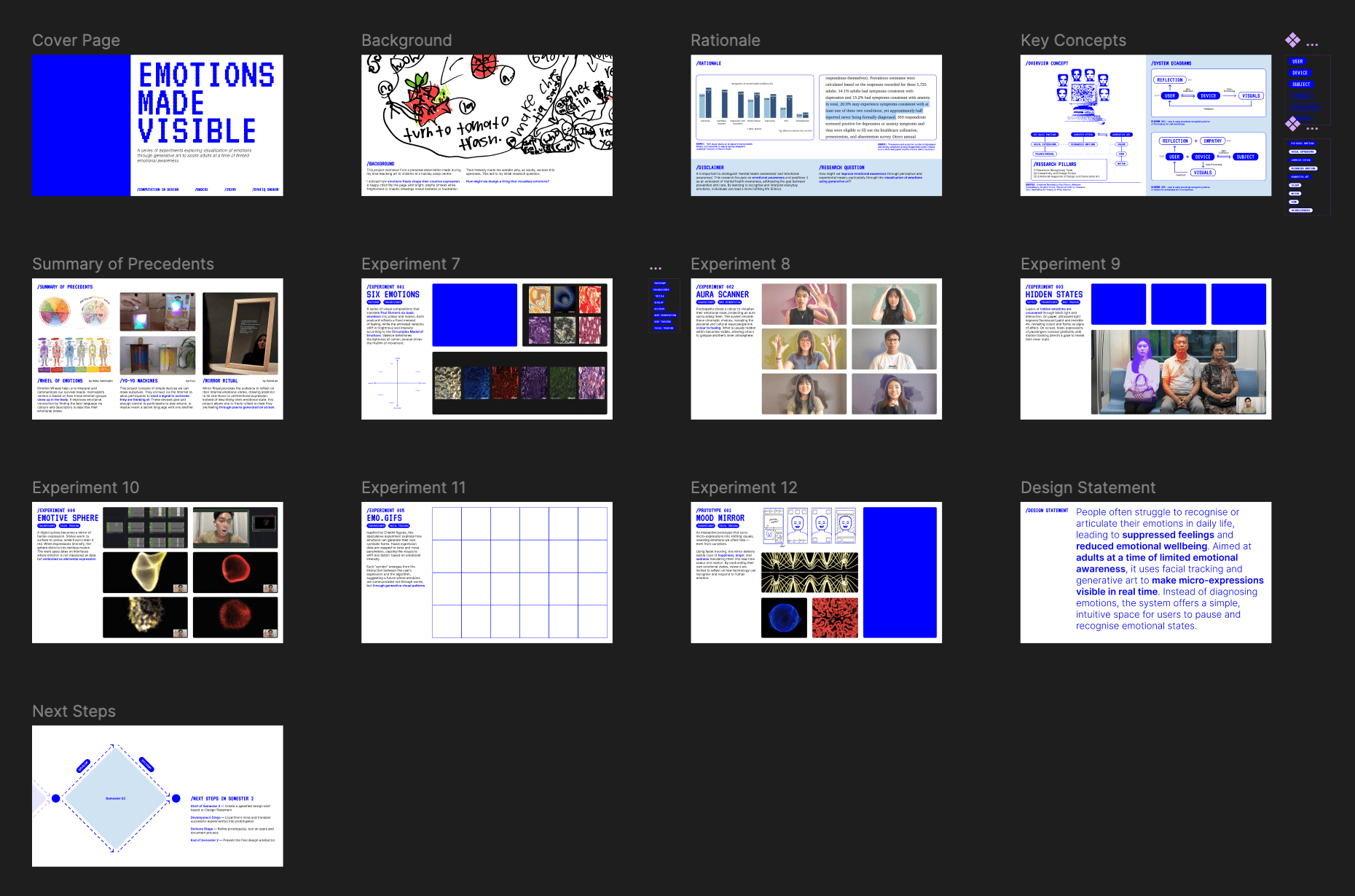
DRAFT DISSERTATION
It has been quite a while since I last touched my dissertation draft. Part of it is because I have been occupied with the latest experiment. But if I am being honest, a big reason is that I have been dreading the writing process. I still was not confident about my research pillars, which made it difficult to structure the literature review properly. I was also unsure how to articulate my research objective, what my overarching research questions were and how to break them into smaller, manageable questions. All these uncertainties made the draft feel daunting.
This week, we finally received our formative feedback for the research proposal outline. I already anticipated that I would not achieve a ‘better-than-good’ grade. I was truly surprised that I did much better than a ‘sub-pass’. What a relief!
To summarise the key feedback, Andreas highlighted that my summaries of readings currently sit separately rather than interacting with one another. As I move into the dissertation, I will synthesise these readings, show relationships between them and articulate the significance of their intersections. He also pointed out that my research objective needs to address clear and specific questions, which aligns with the concerns I had myself. Lastly, there were still inconsistencies in my terminology that I need to refine and standardise.
Apart from the dissertation draft, I also need to prepare the ‘Overview Presentation’ for the Graduation Project submission. Since parts of this deliverable overlap with the dissertation, I will share the updated findings and concepts in the following section.
OVERVIEW CONCEPT
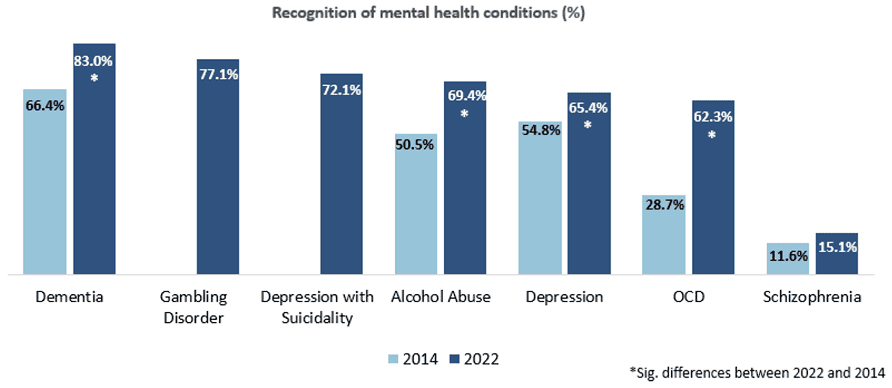
Recently, I came across Singaporean articles that talk about the current state of mental health in Singapore. Statistics from the Institute of Mental Health show that public awareness of mental health issues has improved over the years.
However, one concern I have while developing this dissertation andproject is the need to avoid crossing into the boundaries of ‘mental health’ and its intervention. My work is not meant to diagnose, treat or manage mental disorders. Instead, it focuses on ‘emotional awareness’m which occupies a different and more accessible space. Therefore, it is important this distinction;
① Mental Heath Awareness refers to recognising, managing and seeking help for mental disorders
② Emotional Awareness emphasises on recognising, understanding and expressing one’s own emotions and empathising with others
Keeping this distinction in mind has guided the development of my new research question: “How might we improve emotional awareness through perceptual and experiential means; particularly through the visualisation of emotions using generative art?
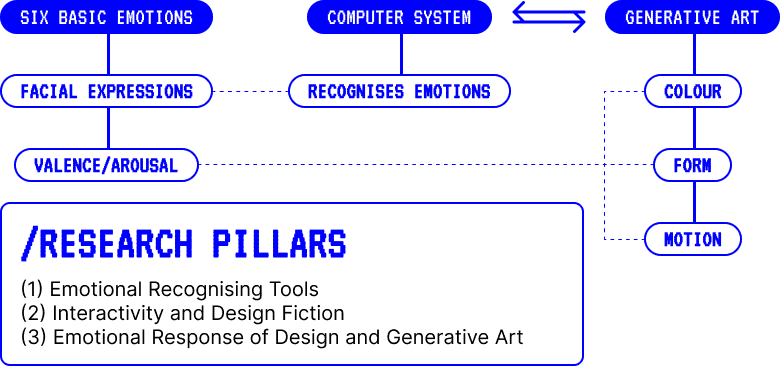
With this shift, I revisited my literature review and refined my research pillars. Previously, the pillars felt slightly disconnected. They were ① Affective Computing and Emotional Recognition, ② Design, Generative Systems and Emotional Responses and ③ Speculation and Design Fiction. However, the updated research pillars are:
① Emotional Recognising Tools consists of existing frameworks such as Plutchik’s Wheel of Emotions and Willcox’s The Feeling Wheel. While these tools are widely used, I found that these tools are often linguistically heavy and overly direct. There is also very little exploration of generative art as an alternative interpretive tool.
② Interactivity and Design Fiction explores how the concept of ‘affective computing’ introduced by Picard can be expanded into the speculative scenarios. This pillar pushes me to consider how emotional data might be collected in the near future and how speculative design could help Singaporeans reflect on their emotional habits and imagine healthier possibilities.
③ Emotional Response of Design and Generative Art focuses on how colour, form and motion influence emotional interpretation. This pillar anchors the visual and experiential dimension of the project.
With the updated research pillars, I began drafting new system flows for the prototypes and interactions I aim to follow through in semester two.
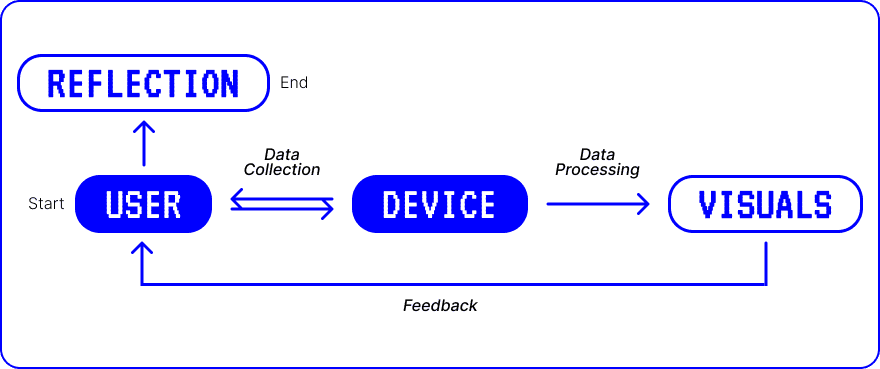
System Diagram 001 User is using an emotional-recognising device on themselves for self-awareness.
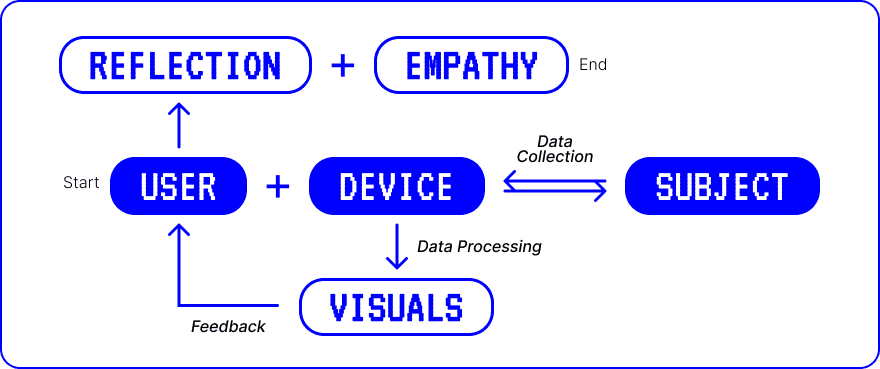
② System Diagram 002 User is using an emotional-recognising device on another person for awareness and to empathise.
After laying down these concepts, I gained much more clarity about what i am actually trying to explore. It helped me organise my thoughts for both the dissertation draft and the overview presentation. On the other hand, I am aware that I still have a significant amount of reading to complete over the semester break. I hope that these new readings will give me stronger grounding and confidence as I refine my research direction.