FINDING A NEW PERSPECTIVE
Since my last consultation with Andreas, there were several aspects of my research I needed to rethink. Before writing my RPO, I had to prioritise identifying my target audience. Andreas had previously advised me to narrow down on the type of adults I wanted to focus on. As I reflect on my earlier experiments, I realised that my initial aim to visualise emotions had unintentionally exposed an underlying discomfort among participants. Some feared the idea of being “seen” emotionally because it made them feel vulnerable. This insight became an entry point for me to explore a deeper question: why do people fear vulnerability?
I came across a TED Talk by Brené Brown, an American researcher with a PhD in Social Work, who discussed the power of vulnerability. She explained that people tend to avoid vulnerability because it is associated with ‘shame’ and ‘fear’. To me, ‘fear ’also extends to the fear of rejection. Her perspective resonated with me deeply.
When I think about opening up to others, I realise that it is easier to share personal thoughts with close friends. I know I could be shameless with them and these people will not judge me. Outside this circle, however, I tend to build walls and only share what is necessary.
Of course, there is a fine line between ‘vulnerability’ and ‘oversharing’. When someone overshares to the point of making others uncomfortable, that is not vulnerability. That’s just a lack of awareness and consideration. Vulnerability itself involves courage and empathy, not self-indulgence.
This reflection also led me to compare adults and children. Children seem to express emotions freely and unapologetically. When they are happy, they laugh till their stomachs hurt. When they are crying, they make sure the entire room can hear them. Or when they are angry, they throw the biggest, dramatic tantrums. As adults, we tend to restrain our emotions, often suppressing what we feel in order to appear “composed” or “mature”.
Within this contrast, it makes me question: Why do adults lose this openness? Why do some people seem less empathetic than others?
VISITING A LIBRARY
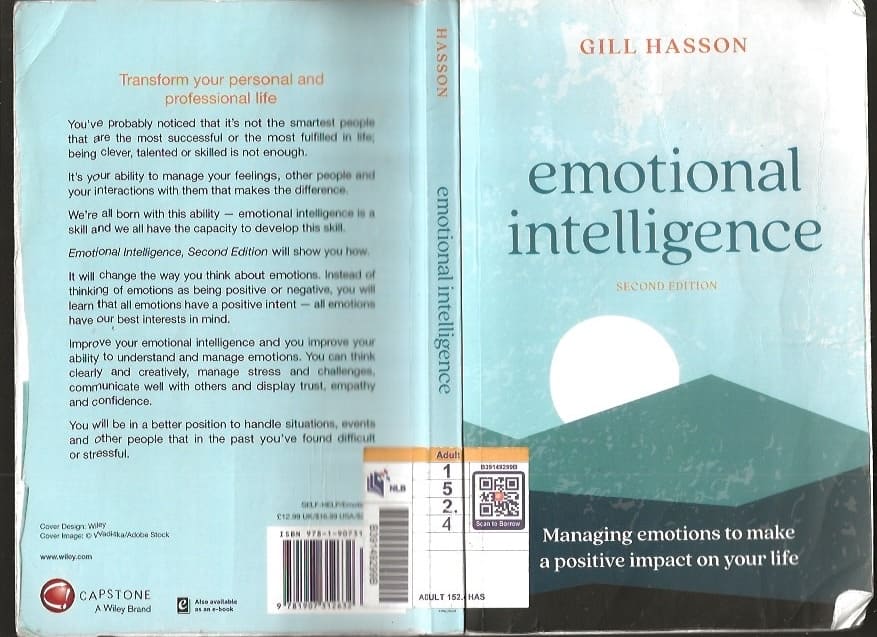
I finally visited the public library after a long time, in hopes of finding answers to my questions. I stumbled upon Emotional Intelligence by Gill Hasson, which discusses how managing our emotions can improve our daily lives and relationships.
One section that stood out to me was about Emotional Suppression. Many people are conditioned to believe that certain emotions are ‘bad’ or ‘wrong’. As a result, they suppress these feelings and only strive for “positive” emotions. However, Hasson argues that suppressing emotions can prevent genuine self-understanding and meaningful connection with others. When emotions are buried, they don’t disappear; they often resurface as tension or passive-aggressiveness.
For example, in professional settings, adults are discouraged from showing anger because it might appear “unprofessional”. Yet, this emotional restraint can create disconnection and possibly hostility within workplaces. People who feel unheard or invalidated might express their frustrations indirectly, leading to a toxic environment. This idea made me realise that the suppression of emotions is not just personal, but also cultural and systemic.
REWRITING MY RPO
Combining Brené Brown’s perspective and Hasson’s ideas helped me to reframe my project’s direction. I believe that vulnerability is a crucial step toward empathy. However, to be vulnerable one must first possess emotional literacy, the ability to recognise, understand and manage emotions. Emotional literacy enables individuals to connect with others on a deeper, more empathetic level.
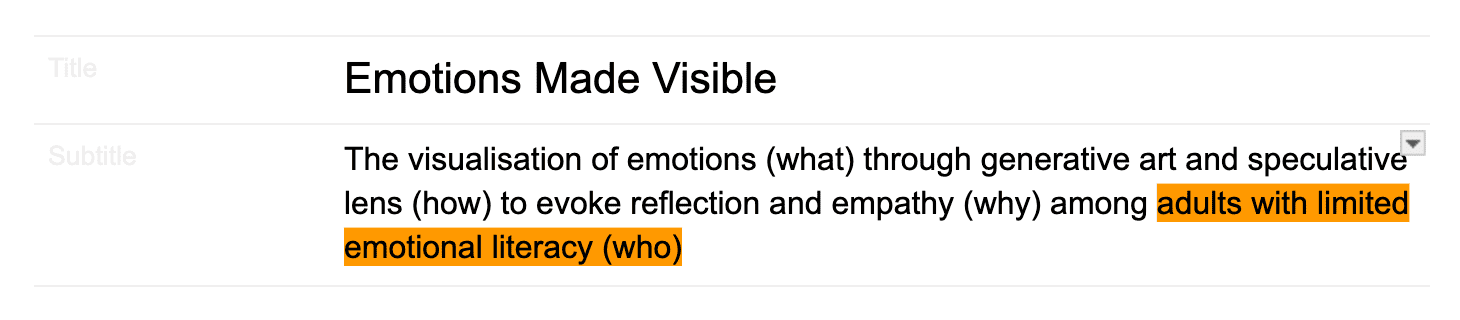
Initially, my big main idea was solely focused on translating emotions into visuals. But over time, I have realised that visualisation of emotions through generative art is just the medium, not the message. My project has evolved into exploring how design can be used as a tool to improve emotional literacy among adults, ultimately fostering empathy and self-awareness. I feel more confident now that my work has a clearer social purpose. I hope that Andreas will see the value in this refined direction…