ROUND TABLE
To gather more feedback on my current progress, I attended a ‘Round Table’ session this week and was assigned to Nicholas and Yasser.

One reassuring takeaway was that my overall concept was clearly understood. However, while the narrative was considered good, both lecturers encouraged me to push it further, particularly the theme of discomfort. They were curious as to how this society I developed operates. What are the rules and how do the citizens carry out their daily lives with the presence of emotion-sensing technology? This made me realised I may not have fully articulated its social implications and lived realities.
I also discovered that throughout the session, I had to repeat that the facial tracking and the aura colour-association are not scientifically accurate. Although I had defined the parameters, the system is ultimately based on my own interpretation rather than being an accurate diagnostic tool. This raised an important concern: instead of repeatedly disclaiming its inaccuracy, I should be more clear and intentional in framing the project as a subjective and interpretive system. This shift in framing could strengthen the conceptual clarity of the work instead of weakening it.
Lastly, one comment that stayed with me was the suggestion to “create an experience that sobers the audience up” during Open Studios. This made me reflect on how I present the project physically. What is the core idea of my presentation? Which works should I prioritise? How should the setup guide their experience?
OPEN STUDIO SETUP DRAFT 01
Following the Round Table session, I began thinking about how I can present my work for Open Studios. The key idea I wanted the audience to reflect on is their perception of emotional visibility and their own level of emotional awareness.
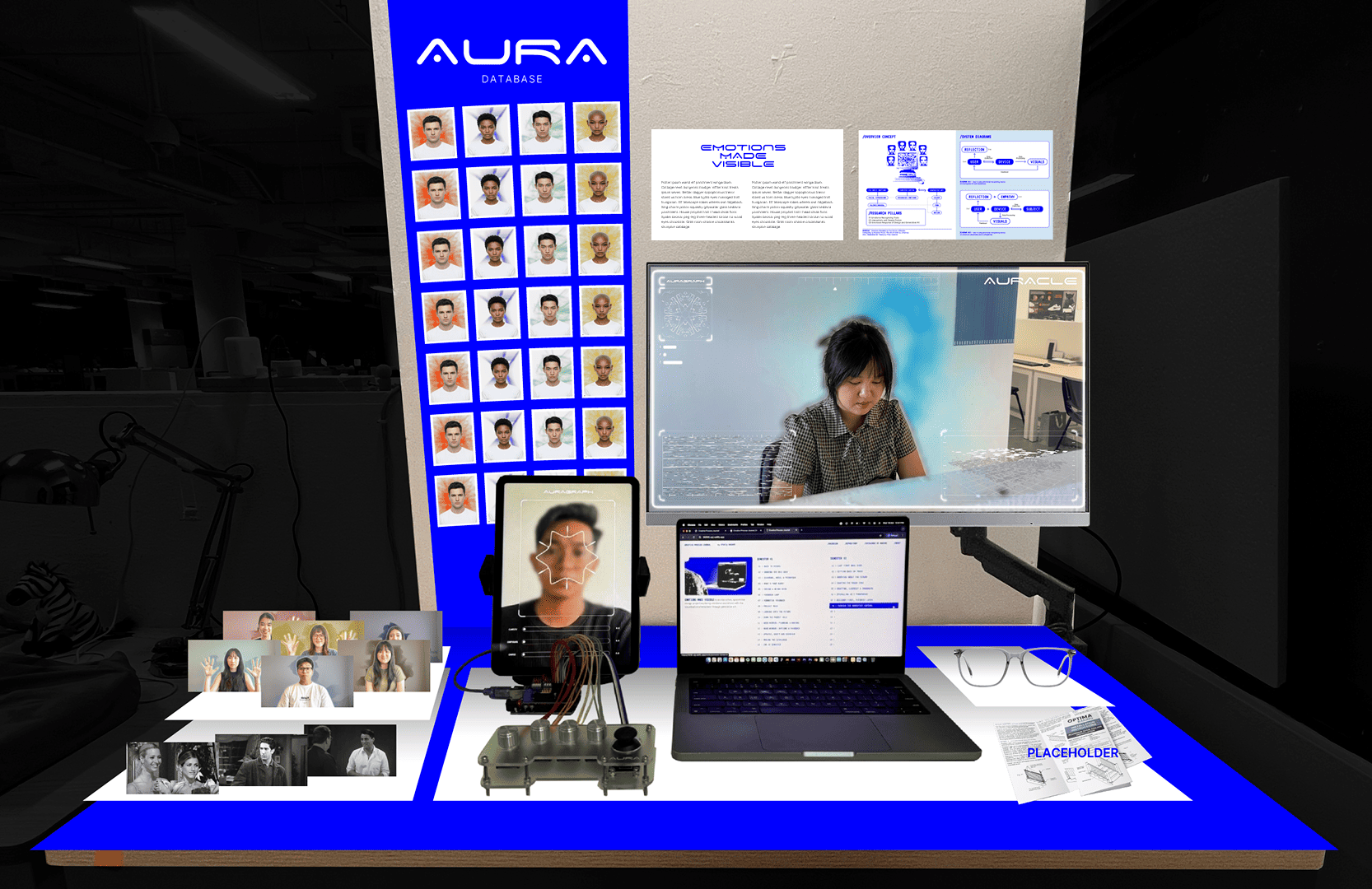
My initial approach was to include selected works from Semester 1, which are Experiment 002 Aura Scanner and Experiment 003 Hidden States. I planned to present these as double-sided printed cards: one side is displaying the visual, the other reveals the associated emotional state. Through this interaction, I wanted visitors to first form their own interpretation and then confront the “revealed” emotion. The intention was to create a moment of reflection: to question how accurately we read emotions.
Building on this, I would then introduce the idea of generative art as a real-time emotional signal, leading into my prototypes AURAGRAPH and AURACLE. Taking Nicholas and Yasser’s advice, I considered setting up a “booth” where visitors could interact with the systems. They would be able to generate their own emotional signatures and see them translate into an aura. They can also engage with the emotion-sensing eyewear interactive system and interpret what the subject on the screen might be feeling.
However, during consultation, Andreas pointed out that this setup felt extremely cluttered. With too many elements presented at once, visitors would have a lot to process and I would likely end up repeating the same explanations over the three days. This made me realise that my current approach prioritised quantity of artefacts over clarity of experience.
He encouraged me to rethink the setup with the principle: minimise effort, maximise narrative. Instead of presenting everything physically, I should consider more focused forms of communication such as video or publication. Through these avenues, they can guide the audience through the narrative more clearly and consistently.